In June I wrote about POC purgatory.
About pharma teams running proofs of concept not to discover value, but to re-audit vendors who sold them a slide.
That post ended with seven words.
“It is time to show the work.”
Fair enough. This is the work.
What follows is hundreds of problems that PAXAFE had to solve as its own customer. Without the identification, solutioning and resolution to these problems, we ourselves wouldn’t have been able to solve our customers’ biggest challenges.
Here are some of my favorites. Some of them I would not have predicted seven years ago. Most of them nobody else in this category has had to touch.
That last part is the point, so let me explain why.
Why these problems were sitting there unsolved
The visibility category was built for freight.
A horizontal control tower has one job: tell you where the truck is and when it will arrive. When the truck arrives, the job is done. Everyone goes home.
Our job starts well before the shipment starts and ends well after a shipment is delivered.
Our job starts when a new lane is first being conceptualized, risk assessments are being performed, lane configurations evaluated, and performance simulated. Our job starts with the digitization of an SOP that’s tied to a lane & shipment record.
It ends when a quality director signs a release decision on product that a regulator can ask about five years from now.
That is not a feature gap. It changes what you have to build all the way down to the ingestion layer.
A platform whose output is an ETA can survive a wrong lane match. A missing logger file. A duplicated shipment record. An alert that fired on a threshold nobody configured.
A platform whose output is a release decision cannot survive any of it.
Every one of those becomes a quality event. Somebody opens an investigation. Somebody writes a deviation. And your product just became the reason Quality is in the room.
Here is the part that took me longer to appreciate than it should have.
Because PAXAFE owns the full lifecycle, we inherited every problem that lives in the seams between the steps:
A horizontal control tower has one job: tell you where the truck is and when it will arrive. When the truck arrives, the job is done. Everyone goes home.
Our job starts well before the shipment starts and ends well after a shipment is delivered.
Our job starts when a new lane is first being conceptualized, risk assessments are being performed, lane configurations evaluated, and performance simulated. Our job starts with the digitization of an SOP that’s tied to a lane & shipment record.
It ends when a quality director signs a release decision on product that a regulator can ask about five years from now.
That is not a feature gap. It changes what you have to build all the way down to the ingestion layer.
A platform whose output is an ETA can survive a wrong lane match. A missing logger file. A duplicated shipment record. An alert that fired on a threshold nobody configured.
A platform whose output is a release decision cannot survive any of it.
Every one of those becomes a quality event. Somebody opens an investigation. Somebody writes a deviation. And your product just became the reason Quality is in the room.
Here is the part that took me longer to appreciate than it should have.
Because PAXAFE owns the full lifecycle, we inherited every problem that lives in the seams between the steps:
- Lane qualification vendors stop at the PDF
- Visibility platforms stop at delivery
- Release tools start with clean data handed to them by somebody else
- Data teams & consultants rely on a combination of the aforementioned to make decisions, whereby the data ‘in between’ isn’t standardized, normalized or contextualized
The problems in between belonged to nobody.
So they went unsolved. And Pharma absorbed them by hand, with people.
When I say we solved these first, that is not a claim about how smart we are. It is a consequence of scope. We hit these problems because we were the only ones standing in the place where they happen.
If you have been reading along, you already know where this is going
The argument in this document is not new. I have been building toward it in public for a while:
- The control tower of today is silent. (The Squeaky Wheel Fallacy, June 2026)
- The control tower of today eliminates point solutions and silos. (It Was Never the App, February 2026)
- The control tower of today is specialized by vertical. (Not All Control Towers Are Created Equal)
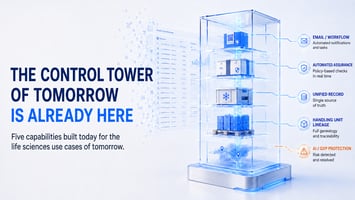
- The control tower of tomorrow is already here. (August 2026)
Those posts made the case. This one shows the receipts.

The data layer nobody else had to build
Before a risk model means anything, the data underneath it has to be good enough to make a regulated decision on. That turned out to be most of the work.
1. We gave up on deterministic parsing
Problem. Most cold chain evidence arrives as a document, not a data feed. A PDF from a passive logger, a spreadsheet export, a proprietary file. Every vendor formats it differently, every software version changes it, and one wrong number means a release decision was made on bad data.
Context. We spent two years writing rule-based parsers, one format at a time. A customer would send a file, it would fail, we would add support, and then a new software version would break it again. Eventually we made the call: the universe of formats is too large to chase, and what we had built had become a research project wearing the badge of a production service. Meanwhile the failure modes were getting more expensive, not less. Reading rows interpreted as configured alarms. Printed timestamps converted into invented numbers. And whole categories we simply could not read at all, most notably reports where the temperature history exists only as a picture of a graph with no data underneath it.
Why it matters. In my June post I told buyers to bring the ugly PDFs and the passive logger files from three different manufacturers to the POC. This is the problem I was pointing at. It is also the gate on automated release. If a human has to open every file and do the math, nothing downstream is automated no matter how good your workflow engine is.
What we did. We stopped treating this as a coverage problem and rebuilt it as a measured one, against a frozen benchmark scored on exact values with no tolerance. The design constraint we held to is the one that matters in a regulated setting: the readings we act on never depend on generated output.
2. One device, evidence scattered across files
Problem. The evidence for a single logger frequently arrives in pieces, in different formats, at different times, from different people. No one file is sufficient, and no one file is authoritative.
Context. A spreadsheet holds thousands of readings with no timestamps on them. The PDF that shipped alongside it holds the activation and deactivation times but not the series. Neither document can produce a defensible time out of range on its own. Then a receiving site emails a third file a day later, sometimes a duplicate, sometimes better data than what came before it. And the logger's own programmed limits may not agree with the product profile the shipment was created under, which is the kind of disagreement that used to pass silently through the system.
Why it matters. This is the difference between a platform that accepts documents and a platform that resolves evidence. Any tool can store three files against a shipment. The question is which numbers the release decision is made on, and whether the person signing can see why those and not the others.
What we did. We treat the device as the thing being evidenced and the documents as competing claims about it, so the record reflects the best available evidence at any moment rather than whichever file happened to arrive last. Disagreements that a person needs to adjudicate are surfaced as exceptions; everything unambiguous resolves without them.
3. Device validation is a procurement trap
Problem. Pharma companies stay locked into a single logger vendor. Not because the hardware is better. Because validating a second vendor's software is prohibitively expensive.
Context. A quality lead at a large biopharma told me they had wanted to add two or three logger vendors for years. Qualifying the device was never the obstacle. Validating each vendor's software was. He described it as getting blood from a stone. One validation effort at his company had been open for over 5+dee years.
Why it matters. This is the constraint that shapes the entire device market, and almost nobody in our category treats it as a software problem. Solve it and device selection stops being a multi-year IT validation program and becomes a device qualification, which is work a quality team already knows how to do in weeks.
What we did. We made CONTXT the validated system of record so the customer validates our platform once and qualifies new devices on sensor accuracy alone. Each new logger vendor arrives as a pre-validated integration, which is only possible because the normalization work sits inside that boundary rather than beside it.
4. The same lane, described two different ways
Problem. Two systems describe one physical lane differently. So the platform either fails to match and quietly creates a duplicate lane profile, or it matches the wrong one. Either way the shipment is now being evaluated against thresholds nobody qualified for it.
Context. The real-world causes are almost funny. "VIENNA" in one system, "WIEN" in the other. A 3PL changing a street address format from N° 4 to NR 4, which broke a match and quietly moved eleven live shipments onto an auto-created lane instead of the qualified one. A destination postal code stored as three digits against a five-digit inbound value. The actual city sitting in the third address line. A geocoder that placed a Lublin address in Bedzin, three hundred kilometers away.
Why it matters. Silent misconfiguration is the worst failure mode in a regulated system. Nothing errors. No alert fires. The shipment looks healthy, alarms evaluate normally, and the thresholds are wrong. You find out at release. Or you do not find out.
What we did. We made lane identity a single resolved decision that every integration defers to, instead of logic each one reimplements slightly differently. And the resolution is recorded, so why a lane matched is an auditable fact rather than an inference somebody makes later.
5. A trailer sensor does not know what it is measuring
Problem. Real-time trailer telemetry carries no packaging context. So the platform cannot tell whether a temperature stream is product temperature or ambient air.
Context. On a naked pallet in a refrigerated trailer, the trailer sensor is effectively measuring the product. Put that same pallet inside qualified passive packaging and the same sensor is measuring the outside of a box that is holding 2 to 8 perfectly well. Treat those two cases identically and you generate deviations on shipments that were never at risk.
Why it matters. False deviations are not cosmetic in Pharma. Each one is an investigation, a quality record, and one more reason for the operations team to stop believing the alerts. This is the squeaky wheel fallacy with a root cause you can actually fix.
What we did. We infer what a sensor is actually measuring from context the shipment already carries, rather than asking a customer to declare it shipment by shipment. The inference flows into the risk model, so one physical sensor is read correctly in both situations.
6. Telemetry volume that behaves like an incident
Problem. Device telemetry isn’t neat. It arrives in bursts, out of order, sometimes with no shipment linked, and sometimes after the shipment has already completed.
Context. Some of this is vendor behavior. Some of it is physics. A logger sitting in a container with no connectivity for nine hours delivers nine hours of readings the moment it surfaces. In my June post I suggested asking a vendor how many buffered device pings it can process at once on a single shipment. That question was not rhetorical. It is the question we had to answer for ourselves.
Why it matters. Cold chain risk is only useful in real time, and the compliance record has to be complete. Dropping a reading is a data integrity problem. Blocking on one is an outage. Neither answer is acceptable.
What we did. We separated the act of receiving data from the act of interpreting it, so volume never gates on processing and a reading that cannot yet be placed is never the reading that gets lost. Nothing in the compliance record depends on data arriving in the right order.

Turning data into a decision
Clean data is table stakes. The harder question is what the data means for the product, and that is a question the freight platforms never had to answer.
7. The shipment is the wrong unit of truth
Problem. Visibility platforms model a shipment. Pharma quality decisions are made on physical units inside the shipment, and those units nest and change granularity as they move.
Context. A vial sits in a carton, in a box, on a pallet. One logger might cover a pallet on the primary leg and a single box downstream. One shipment can carry sixteen pallets with sixteen independent release decisions. A batch can split across destinations, and the half that went to Germany is not bad because the half that went to France is. Real shipments routinely blow past twenty active devices, which is why we support 100+ devices on a single shipment record. (Good luck processing all of that buffer data.
Why it matters. If the data model cannot express containment, you cannot release part of a shipment. You cannot quarantine one unit and let the rest go. You cannot trace a batch. You have a dashboard with a map on it.
What we did. We model the physical unit rather than the shipment, and we carry it through every layer from ingestion to release instead of reconstructing it at the end. Every integration populates it, including the ones where the carrier tells us nothing about physical units at all.
8. Alert noise, which is the actual reason people abandon these systems
Problem. Device-native alerting fires on every threshold breach. A temperature excursion is not the same thing as a product risk, and treating them as the same buries the team that has to act.
Context. We have displaced two named risk platforms at a vaccine manufacturer specifically over alert noise. The clarifying case is the one I keep coming back to: a thirty minute excursion outside 2 to 8, stability budget still above ninety percent, packaging thermal life at twice the remaining transit, and a three hour airport delay. The correct answer is that the shipment is on track. Getting that answer right requires knowing [and understanding!] the product, the packaging, the route, the site specific instructions and some other attributes from the SOP. Not just the sensor.
“We extend that same verdict to shipments carrying no real-time device at all, which brings risk intelligence to the large majority of Pharma volume that has never had IoT in the box.”
Why it matters. The category sells visibility. Visibility that produces four hundred alerts a week is a liability. What a quality director needs is one verdict they will defend in an audit. The future is not more alerts. It is better silence.
What we did. Live Risk resolves delivery, temperature, and packaging into a single On-Track, At-Risk, or Off-Track verdict against the qualified product profile, with the contributing factors exposed underneath it. We extend that same verdict to shipments carrying no live device at all, which brings risk intelligence to the large majority of Pharma volume that has never had a logger in the box.
9. Stability budget does not reset when the truck changes
Problem. Every leg of a journey is an independent shipment, and every independent shipment starts with a full stability budget. Product does not work that way. Exposure is cumulative across the entire journey.
Context. Product moves from manufacturing to primary distribution to secondary to last mile, and in most platforms every one of those is a separate record starting at 100 percent. A pallet that consumed half its allowable time out of refrigeration on leg one arrives at leg two with half remaining. Not all of it. Quality teams reconstruct this by hand in their QMS today.
Why it matters. This is the blocker sitting underneath automated release. A reviewer looking at ninety minutes of exposure on one leg and sixty on the next, against a real three hour limit — across multiple devices — has no way to see the total.
Exposure carries over across legs and through repackaging, so a leg begins where the last one ended rather than at full budget.
What we did. Exposure carries over across legs and through repackaging, so a leg begins where the last one ended rather than at full budget. The calculation is single and non-negotiable, it refuses to produce a number when the journey it depends on is incomplete, and a correction upstream reopens anything that was released on the old basis.

Making it defensible
Speed is worth nothing here if the output cannot survive an audit. This is the part of the problem the AI-native entrants have not reached yet.
10. Lane qualification, where eighty percent of the work is typing
Problem. Product cannot move on a new corridor until the lane is qualified with documented evidence. That takes four to eight weeks per lane, and large shippers manage thousands, even tens of thousands, of lanes.
Context. The breakdown is the interesting part. Roughly eighty percent of the effort goes into creating documents: hand-authoring SOPs, transcribing forwarder specifications, analyzing detailed vendor risk questionnaires, building questionnaires that run to hundreds of questions per warehouse. Only twenty percent goes to the review that actually adds quality. Provider capability data lives nowhere durable, so the same forwarder returns different specs to different askers and every customer rebuilds the dataset from scratch.
Why it matters. Recent FDA guidance permits AI-generated documentation with human review, which opens the door. But generation is not the hard part and it is not the moat. In a GxP shop, an answer you cannot defend in an audit is worthless no matter how fast you produced it.
What we did. We inverted the ratio, so the time goes into review rather than authoring. Everything the system produces carries a traceable origin, and a human's judgment permanently outranks anything the system would generate later, which is the property that makes the output defensible rather than merely fast.
And here is the part that matters more than the time savings.
Qualification does not end at a PDF. It publishes a lane profile that configures the runtime, so Command Center and Live Risk monitor every shipment against the exact limits the qualification established. One risk model spans qualification and live monitoring.
Qualification stops being a document factory and becomes the configuration source for everything downstream.
Can the qualified lane inform monitoring? Can actual performance update the assumptions used to qualify the lane? I asked those questions in June as things buyers should demand. As far as I know, PAXAFE is the only technology platform that has closed that loop.
11. Putting AI inside a Part 11 workflow without breaking it
Problem. Regulated Pharma cannot accept a model in the release decision path. But exclude AI from the workflow entirely and you have built a dashboard with a chat window bolted to the side of it.
Context. Enterprise buyers are already pointing general-purpose models at their cold chain data. Those models do not know the customer's SOP thresholds, their qualified lanes, or their time out of refrigeration parameters. So the output is confident and useless. Meanwhile our own buyers increasingly have AI teams in the room who will ask precisely where the model sits relative to the controlled record. That is a good question and most vendors do not have an answer to it.
Why it matters. Every quality organization we talk to asks this. Having a coherent answer is itself the differentiator, and it is the reason the "we will just use ChatGPT" objection turns into a conversation instead of a loss.
What we did. We drew the boundary at the approval gate. The controlled workflow is what gets qualified, and nothing the AI produces is a record until a person approves it inside that workflow. Athena reasons over our own structured cold chain model rather than a general corpus, and an enterprise can bring their own model provider against our compliance-grade data layer.
12. Shipping validated software at the speed of a startup
Problem. Formal qualification and fast release are structurally opposed. Validation wants traceable, repeatable, documented evidence. Modern software delivery wants to ship continuously.
Context. Product release directly supports disposition, which puts it in the highest risk classification we carry. Qualification requires end-to-end test evidence traceable back to specific requirements. The default industry answer is to slow down: quarterly releases, manual regression, an evidence binder assembled by hand in the weeks before an audit.
Why it matters. For an enterprise Pharma buyer, "can you produce a qualification evidence package" is a gating question, not a preference. And it is the most durable moat we have, because a competitor cannot bolt this on. They would have to rebuild their development lifecycle from the bottom. GxP as an add-on to an established SDLC with millions of lines of code does not work.
What we did. Qualification evidence is a byproduct of delivery rather than a documentation project, and the pipeline will not ship when the traceability is incomplete. Delivery is gated per customer and per version, so a validated customer stays on a validated version while development keeps moving.
To be clear about what the automation does not do. A green pipeline is not a validated state. Final acceptance of every qualification package stays a controlled human quality decision.
CSA in the pipeline. CSV in the record. The machines run the tests, and Quality owns the validated state.
What this list actually says
I did not set out to build fourteen novel things. Nobody does.
Every one of these started as a customer telling us something was broken, or as a shipment that got evaluated wrong.
The pattern is what I would point to.
In every single case, the reason the problem went unsolved is that solving it requires standing in more than one place at once.
- Cumulative stability budget requires owning both the risk engine and the release workflow.
- Publishing a lane profile into the runtime requires owning both qualification and live monitoring.
- Device validation as a procurement argument requires owning the ingest layer and the compliance posture on top of it.
- Resolving evidence across documents requires owning parsing, the product profile, and the disposition decision together.
- Handling unit containment requires owning integration, monitoring, and release at the same time.
Horizontal platforms are not going to build these. From where they sit, these are not problems. They are somebody else's problems.
Expanding from life sciences into commodities is possible. Expanding from commodities into life sciences is not.
These 12 problems show a small subset as to why.
PAXAFE supports some of the largest Pharma & Life Sciences enterprises, as well as some of the fastest growing, most innovative 'small’ pharmaceutical companies (there's no such thing as small with a $B after your name)
Almost every problem on this list came out of that work.
I expect my next 12 favorites will too.
The industry has bought enough slides.
About PAXAFE
PAXAFE is a GxP decision intelligence platform that strives to put the end-to-end cold chain on autopilot.
Acting as the system of record for every time-, temperature-, and value-sensitive shipment and batch, PAXAFE works with cold chain manufacturers and service providers to eliminate silos, ensure compliance, and empower teams with contextual intelligence to maximize patient trust and customer outcomes.
FAQ
Why is parsing pharmaceutical cold chain sensor data so difficult?
Most cold chain evidence arrives as documents, not clean data feeds — PDFs from passive loggers, spreadsheet exports, proprietary vendor formats that change with every software update. Some reports only show temperature history as a picture of a graph with no underlying data at all. Rule-based, format-by-format parsing can't keep pace, which is why one wrong reading on unmeasurable evidence can put a release decision on bad data.
What is a cumulative stability budget in cold chain shipping?
A cumulative stability budget tracks a product's total allowable time out of refrigeration across an entire journey, not per leg. Most platforms treat each leg of a shipment as an independent record starting at a full budget, which understates real exposure. A cumulative model carries remaining exposure forward from one leg to the next, so a reviewer sees total exposure against the real limit rather than reconstructing it by hand.
Can AI be used in a GxP, 21 CFR Part 11 regulated release decision?
AI can support a regulated release decision, but it can't make one unsupervised. The defensible approach draws the boundary at the approval gate: the AI's output isn't a controlled record until a qualified person reviews and approves it inside the validated workflow, and the model reasons over the company's own structured SOPs and lane data rather than a general-purpose corpus.
What is Computer Software Assurance (CSA), and how does it apply to validating cold chain software?
CSA is the FDA's risk-based approach to software validation, which pairs with automated testing in the delivery pipeline (CSA in the pipeline) while final acceptance of a validated state remains a controlled human quality decision (CSV in the record). A green automated pipeline isn't itself a validated state — it's evidence that feeds a human quality decision.
Why can't horizontal supply chain visibility platforms solve pharma-specific cold chain problems?
Horizontal control towers are built to answer one question: where is the shipment and when will it arrive. Pharma cold chain problems — cumulative stability budgets, lane qualification feeding live monitoring, device validation as a compliance question, GxP-defensible AI — all live in the seams between steps that a generic platform was never built to own end to end. Solving them requires owning the full lifecycle from ingestion through release, not just visibility in transit.
What causes false temperature excursion alerts in cold chain monitoring?
False excursion alerts typically happen when a system treats every threshold breach as equally risky without accounting for context — a trailer sensor that can't distinguish product temperature from ambient air inside qualified packaging, or a brief excursion evaluated without remaining stability budget, packaging thermal life, or route delay factored in. Resolving these into a single risk-based verdict, rather than alerting on every raw threshold breach, is what separates real risk intelligence from noise.