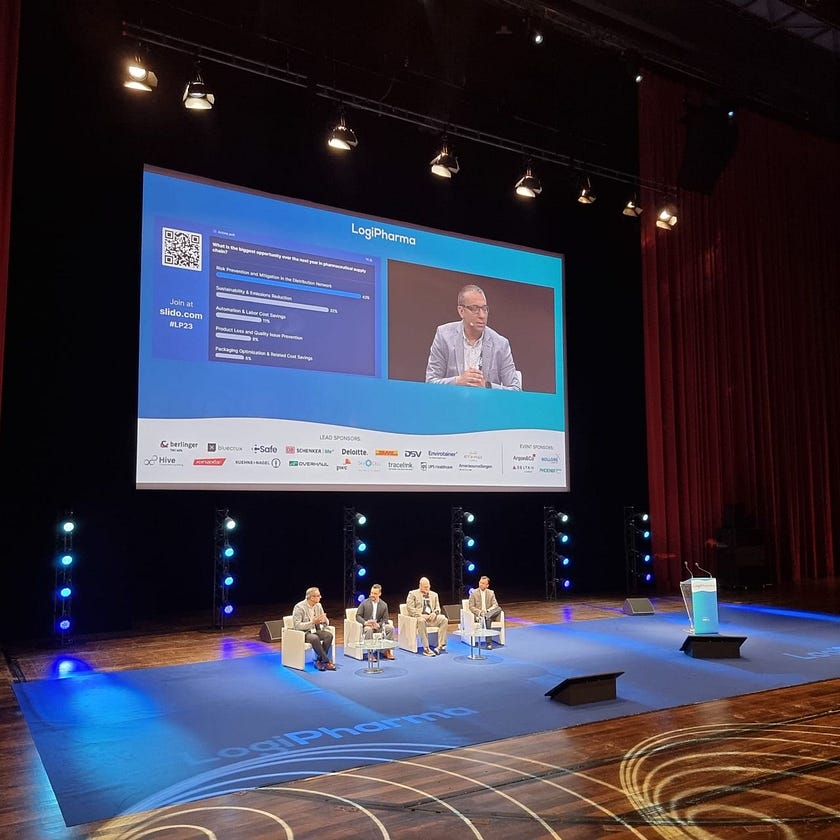
A panel discussing the emergence of risk management in the pharmaceutical supply chain....

The Pharmaceutical Control Tower of Tomorrow Already Exists Today
Since 2019, PAXAFE has become the leading cold chain decision intelligence platform purpose built for Cold Chain.
You can follow the evolution of our outlook and perspective through my own words:
- The control tower of today is silent
- The control tower of today eliminates point solutions and silos
- The control tower of today is specialized by vertical
(For the full evaluation framework behind that last point, see our guide to pharmaceutical control towers.)
PAXAFE's GxP quality compliance and logistics orchestration platform supports some of the biggest names in pharma, biotech, logistics, packaging, and IoT. At its core, this vision is what got us here.
But I want to be clear: the control tower of today is NOT the control tower of tomorrow.
7 years ago, the very first slide I built to describe PAXAFE was comprised of five words: context, visibility, diagnosis, prescription, and automation. Each word was a necessary feeder to unlock the capability of the next word. For example, you cannot have visibility without context, just as you cannot have prescription without accurate diagnosis.
At the base of this house of cards is the word upon which we built and named our entire platform – CONTXT.
And in today’s version, nothing has really changed. Automation is now ‘agentic’ – but guess where the industry is still stuck?
Point 3! Lack of context = Bad visibility = nothing downstream works as intended.

PAXAFE has sought out to change that by creating the first purpose-built cold chain decision intelligence platform that actually works, with context at its core.
Here are five ways that CONTXT has evolved over the past 18 months in support of what we’ve identified as the control tower VISION of tomorrow:
1. Visibility conformed to Pharma tracking
Okay, I have to admit — this one sounds so simple. It’s not.
This is something Pharma is already using today, that they needed like 15 years ago… because it’s not natural for Pharma to track products by shipment ID if they don’t have to.
Most visibility control towers are built for basic tracking. Track a device ID. Track a product ID. Track a shipment ID, a container ID. One device per shipment record. No mixed real-time and conventional devices on a single shipment. No split shipment support — and forget tracking E2E product lineage through manufacturing, warehousing and transit — across all legs of the supply chain (raw materials, manufacturing, distribution and last mile).
PAXAFE tracks by handling unit, exactly how life sciences leaders do: pallet ID, box ID, with product, packaging, batch, material code, dosage, serialization, and expiry nested to follow.
Up to 100 devices per single shipment record (good luck processing all of that buffer data). Real-time and conventional. Split shipment support, product release, and full end-to-end product TIR / TOR and batch lineage through manufacturing, warehousing, and in-transit logistics — the same device-agnostic visibility we've built Command Center around from day one.

2. The platform disappears into how you already work
The UI and the application layer will become optional. Tomorrow's control tower will be embedded into your exact way of working. It will live in your email, your Teams, your Slack — your workflow today, powered by an ‘invisible’ command center underneath.
The irony is that you can't jump to tomorrow's control tower without building the full processing and normalization layers, integration layer, and other core functionality that make today's platform great. You need to crawl and walk today to run tomorrow. Customers who become proficient in understanding the inner workings of the platform today will gain the greatest benefit from tomorrow's version.
At PAXAFE, we’ve built the fundamental infrastructure layers to power an E2E cold chain decision support system, whether it’s through PAXAFE’s CONTXT application, or embedded across your favorite tools!

3. GxP and CSV are evolving
Validation in GxP software has traditionally been a paperwork exercise: a binder of scripted tests assembled after the software was already built, repeated wholesale every time something changed. At PAXAFE we’re taking a different path, one aligned with FDA’s Computer Software Assurance (CSA) guidance, GAMP 5, and Annex 11. Assurance should be proportionate to risk and should live inside the software lifecycle, not trail behind it.
Every GxP-relevant requirement in CONTXT carries a risk assessment tied to its intended use, and the depth of testing scales accordingly. Functions that touch regulated release decisions get rigorous scripted qualification with full traceability, while lower-risk areas get leaner scenario-based verification. Less burdensome evidence where risk is low, never no evidence.
What makes this work is that we’ve built qualification directly into our delivery pipeline. Automated tests execute against each acceptance criterion and produce complete, traceable evidence (who ran what, when, what was actually observed, pass or fail) as a byproduct of delivery rather than a separate documentation project. Just as importantly, we’re clear about what the automation doesn’t do. A green pipeline is not a validated state, and final acceptance of every qualification package remains a controlled human quality decision. CSA in the pipeline, CSV in the record: the machines run the tests, and Quality owns the validated state.
4. Silos will continue to disappear
Today, there are silos everywhere. One platform or home-grown project geared toward tracking TIR/TOR in manufacturing. Many WMS and ERP systems. Tons of visibility tools from IoT devices, packaging providers, and carriers. QMS with product stability data and SOPs. Raw material and API lanes. Manufacturing. Distribution. Last mile. This platform for cold chain. This platform for tracking. This process for quality release. Everything disconnected, everything has its own "thing."
PAXAFE has made great strides in showing how all of the above can be consolidated — from siloed point solutions where decisions and data don't flow through, into one unified system of record. That's the same argument behind real cold chain data consolidation: the fix was never another point tool, it's reconciling the record.

5. Control towers will become verticalized and specialized
Think about the visibility control towers of the last decade, as well as the broader supply chain orchestration platforms that have been around for decades. All of these tools, yet pharma sees more product loss, inefficiency, and decision paralysis than ever.
Generic is adequate for commodities and retail. Generic cannot meet the needs of a pharma logistics control tower operating under GxP requirements. And the pharma industry has a lot of tech debt scar tissue to show for it.
Going broad before going deep is certainly a choice. But for Pharma, it’s the wrong choice.
AI as a bolt-on doesn't work. GxP as an add-on to an existing SDLC and an established infrastructure with millions of lines of code doesn't work. These two things are either built into your DNA from the ground up, or they don't work. That's why expanding from life sciences into commodities is possible. Expanding from commodities into life sciences is not.
The control tower of tomorrow demands more than ‘you have a device alert – temperature out of range.’ – what the heck are we supposed to do with that???
Tomorrow's control towers will be AI-native and will have GxP in their DNA before they turn three years old.
Today's established control tower providers will bow out of life sciences, or invest heavily to hyper-specialize (although I argue that the really big ones can’t afford to do this without acquisition) — realizing that the upside potential of solving the most difficult problem in logistics, the cold chain problem, unlocks the privilege of solving some of the most interesting problems in supply chain. We go deeper on what that specialization actually requires — end to end, from lane qualification through automated product release — in the rest of our blog.
Take a look at what is possible with a specialized command center. Your diagnosis is precise and specific. Your recommendations are actionable. Agents can augment action to drive productivity and speed to resolution.

Explore PAXAFE's Platform
- CONTXT — Supply Chain Visibility & Orchestration
- Lane Intelligence — Risk Assessment
- Command Center — Pharma Control Tower
- Product Release — GxP Automation
- Workflows — Digital Disposition & Automation
- Agents — Athena AI for Pharma Supply Chain
- Insights — Cold Chain Analytics
About PAXAFE

FAQ
What makes a control tower "pharma-grade" instead of just a generic logistics control tower?
A pharma-grade control tower is built around GxP from the ground up — handling unit-level traceability (pallet, box, batch, serialization), device- and carrier-agnostic ingestion, lane qualification tied to SOPs, and GxP-validated product release. Generic supply chain control towers are built for commodity visibility and bolt compliance on afterward, which is why they struggle to meet regulated pharma requirements. For a full evaluation framework, see our guide to pharmaceutical control towers.
What is the difference between supply chain visibility and supply chain orchestration?
Visibility tells you where a shipment is and what its temperature was. Orchestration goes further — it connects that data to a decision, like whether a lane still qualifies, whether a shipment is on track for automated release, or whether a workflow should trigger automatically. A control tower that only offers visibility still requires a human to manually decide what to do with the information; an orchestration layer acts on it.
What is Computer Software Assurance (CSA), and how is it different from Computer System Validation (CSV)?
CSA is the FDA's risk-based approach to validating production and quality system software, finalized in 2025 and updated in February 2026. Unlike traditional CSV, which applies the same exhaustive scripted testing to every system regardless of risk, CSA scales validation effort to actual patient-safety and product-quality risk, and explicitly accounts for AI/ML systems and cloud-based software — a better fit for platforms that update continuously rather than once a year.
Why can’t AI or GxP be "bolted on" to an existing control tower platform?
Because both require decisions made at the architecture level, not the feature level: how data is structured, how validation is scoped, how audit trails are generated. Retrofitting AI onto a platform not built for it means the AI can't be grounded in real SOPs and lane history. Retrofitting GxP onto a platform not built for it means validation becomes a slow, manual exercise layered on top of code that wasn't designed to be audited. Both have to be present in the system's DNA from the start.